Note
Go to the end to download the full example code.
Quickstart: temporalcv in 50 lines
This is the fastest way to understand temporalcv’s core value proposition.
- Run this example:
python examples/00_quickstart.py
- What you’ll learn:
How validation gates catch data leakage
The HALT/WARN/PASS decision framework
Basic walk-forward cross-validation
import matplotlib.pyplot as plt
import numpy as np
from sklearn.linear_model import Ridge

from temporalcv.cv import WalkForwardCV
from temporalcv.gates import gate_signal_verification, gate_suspicious_improvement, run_gates
from temporalcv.viz import apply_tufte_style

# Generate simple time series data
rng = np.random.default_rng(42)
n = 200
y = np.cumsum(rng.standard_normal(n))  # Random walk
X = np.column_stack([np.roll(y, i) for i in range(1, 6)])  # Lag features
X, y = X[5:], y[5:]  # Remove NaN rows

# Step 1: Walk-forward cross-validation (the right way)
cv = WalkForwardCV(n_splits=5, extra_gap=1, test_size=20)
print("Walk-Forward CV splits:")
for i, (train, test) in enumerate(cv.split(X, y)):
    print(f"  Fold {i+1}: train={len(train)}, test={len(test)}, gap enforced")

# Step 2: Fit model and compute errors
model = Ridge(alpha=1.0)
all_errors = []
persistence_errors = []
for train_idx, test_idx in cv.split(X, y):
    model.fit(X[train_idx], y[train_idx])
    preds = model.predict(X[test_idx])
    all_errors.extend(np.abs(y[test_idx] - preds))
    persistence_errors.extend(np.abs(y[test_idx] - y[test_idx - 1]))

model_mae = np.mean(all_errors)
baseline_mae = np.mean(persistence_errors)
print(f"\nModel MAE: {model_mae:.4f}")
print(f"Baseline MAE: {baseline_mae:.4f}")
print(f"Improvement: {(1 - model_mae/baseline_mae)*100:.1f}%")

# Step 3: Run validation gates
print("\n--- Validation Gates ---")
gates = [
    gate_signal_verification(model, X, y, n_shuffles=100, random_state=42),
    gate_suspicious_improvement(model_mae, baseline_mae, threshold=0.20),
]
report = run_gates(gates)
print(report.summary())

# Step 4: Make decision
if report.status == "HALT":
    print("\n⛔ HALT: Investigate before deploying!")
elif report.status == "WARN":
    print("\n⚠️  WARN: Proceed with caution")
else:
    print("\n✅ PASS: Safe to continue")
Walk-Forward CV splits:
  Fold 1: train=94, test=20, gap enforced
  Fold 2: train=114, test=20, gap enforced
  Fold 3: train=134, test=20, gap enforced
  Fold 4: train=154, test=20, gap enforced
  Fold 5: train=174, test=20, gap enforced

Model MAE: 0.8162
Baseline MAE: 0.7818
Improvement: -4.4%

--- Validation Gates ---
============================================================
VALIDATION REPORT
============================================================

  [HALT] signal_verification: Permutation test: p=0.0099 < α=0.05 (model has signal)
  [PASS] suspicious_improvement: Improvement -4.4% is reasonable

============================================================
OVERALL STATUS: HALT
============================================================

HALTED GATES (require investigation):
  - signal_verification: Model has predictive signal. Investigate source: legitimate temporal patterns (expected for AR models) OR data leakage (check feature engineering).

⛔ HALT: Investigate before deploying!
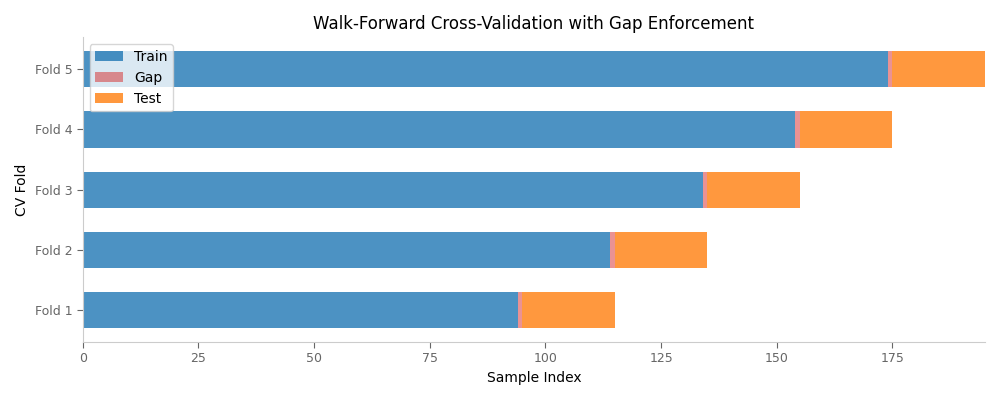
Visualize Walk-Forward CV Folds
This plot shows how WalkForwardCV splits the data temporally, with training (blue) and test (orange) sets, and the gap between them.
fig, ax = plt.subplots(figsize=(10, 4))

cv = WalkForwardCV(n_splits=5, extra_gap=1, test_size=20)
n_samples = len(X)

for fold_idx, (train_idx, test_idx) in enumerate(cv.split(X, y)):
    # Training set
    ax.barh(
        fold_idx,
        len(train_idx),
        left=train_idx[0],
        height=0.6,
        color="#1f77b4",
        alpha=0.8,
        label="Train" if fold_idx == 0 else "",
    )
    # Gap
    gap_start = train_idx[-1] + 1
    gap_end = test_idx[0]
    ax.barh(
        fold_idx,
        gap_end - gap_start,
        left=gap_start,
        height=0.6,
        color="#d62728",
        alpha=0.5,
        label="Gap" if fold_idx == 0 else "",
    )
    # Test set
    ax.barh(
        fold_idx,
        len(test_idx),
        left=test_idx[0],
        height=0.6,
        color="#ff7f0e",
        alpha=0.8,
        label="Test" if fold_idx == 0 else "",
    )

ax.set_xlabel("Sample Index")
ax.set_ylabel("CV Fold")
ax.set_yticks(range(5))
ax.set_yticklabels([f"Fold {i+1}" for i in range(5)])
ax.set_title("Walk-Forward Cross-Validation with Gap Enforcement")
ax.legend(loc="upper left")
ax.set_xlim(0, n_samples)

# Apply Tufte styling
apply_tufte_style(ax)

plt.tight_layout()
plt.show()
Total running time of the script: (0 minutes 1.310 seconds)