Note
Go to the end to download the full example code.
Example 03: Statistical Tests for Forecast Comparison
This example demonstrates temporalcv’s statistical testing framework for rigorously comparing forecasting models.
Real-World Case Study: Is Your Model Better Than Persistence?
The persistence (naive) baseline — predicting y[t+1] = y[t] — is surprisingly hard to beat in many time-series domains. Before deploying a complex model, you should statistically verify it outperforms this simple baseline.
Tests Covered: 1. Diebold-Mariano test (DM 1995): Compares predictive accuracy 2. Pesaran-Timmermann test (PT 1992): Tests directional accuracy 3. HAC variance (Newey-West): Corrects for serial correlation
Key Insight
A model with lower MAE doesn’t guarantee significant improvement. The DM test quantifies whether the difference is statistically meaningful, accounting for serial correlation in forecast errors (critical for h>1 step forecasts).
Usage
python 03_statistical_tests.py
Requirements
pip install temporalcv scikit-learn scipy
======================================================================
TEMPORALCV: Statistical Tests for Forecast Comparison
======================================================================

Data: 148 observations of AR(1) process
Persistence parameter (phi): 0.9

======================================================================
PART 1: Naive Comparison (Misleading!)
======================================================================

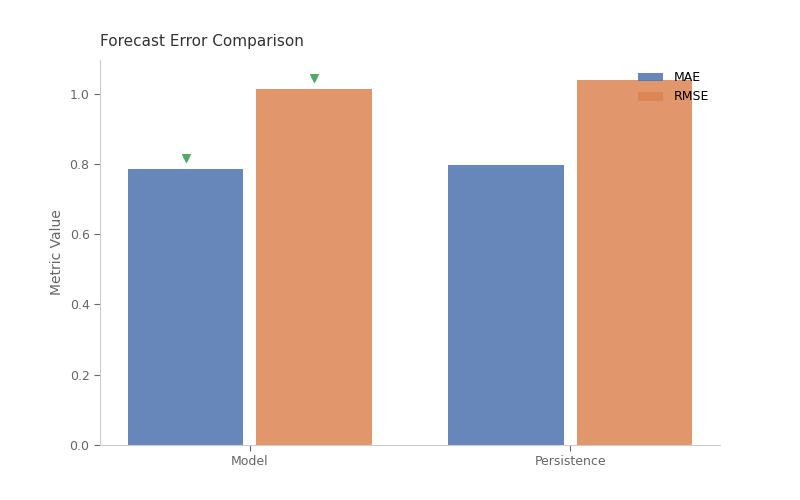
  Model MAE:       0.7854
  Persistence MAE: 0.7955
  Improvement:     1.3%

  Problem: Is this improvement statistically significant?
  The MAE difference could be due to random chance!

======================================================================
PART 2: Diebold-Mariano Test (Rigorous Comparison)
======================================================================

H0: Models have equal predictive accuracy
H1: Models have different predictive accuracy

--- Squared Error Loss ---
  DM(1): -0.793 (p=0.4288)
  Mean loss difference: -0.0512
  Significant at α=0.05: No

--- Absolute Error Loss ---
  DM(1): -0.412 (p=0.6809)
  Mean loss difference: -0.0102
  Significant at α=0.05: No

  Interpretation: Despite the lower MAE, the model does NOT
  significantly outperform persistence at the 5% level.
  → This is common for high-persistence time series!

======================================================================
PART 3: Multi-Step Forecasting (HAC Variance)
======================================================================

For h-step forecasts, errors are serially correlated.
The DM test uses HAC (Newey-West) variance estimation.

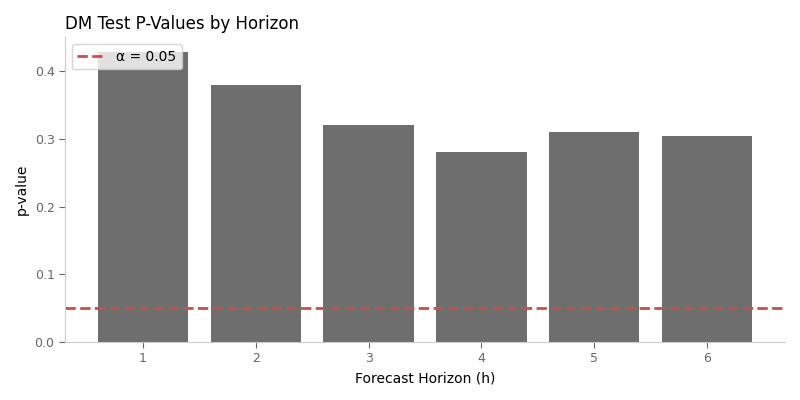
  h=1: DM(1): -0.793 (p=0.4288)

  h=2: DM(2): -0.882 (p=0.3794)

  h=4: DM(4): -1.084 (p=0.2801)

  Note: HAC adjustment increases standard errors for h > 1,
  making it harder to reject H0 (more conservative).

======================================================================
PART 4: Pesaran-Timmermann Test (Directional Accuracy)
======================================================================

H0: Model direction predictions are independent of actual directions
H1: Model predicts direction better than random chance

  PT: 55.1% vs 50.3% expected (z=0.827, p=0.2042)
  Observed accuracy: 55.1%
  Expected (random): 50.3%
  Significant at α=0.05: No

======================================================================
WHEN TO USE WHICH TEST
======================================================================

    ┌─────────────────────────────────────────────────────────────────────┐
    │ Question                           │ Test to Use                   │
    ├─────────────────────────────────────────────────────────────────────┤
    │ Is Model A better than Model B?    │ Diebold-Mariano (DM)          │
    │ Does my model predict direction?   │ Pesaran-Timmermann (PT)       │
    │ Is improvement > 0 (one-sided)?    │ DM with alternative="less"    │
    │ Multi-step forecast (h > 1)?       │ DM with HAC variance          │
    └─────────────────────────────────────────────────────────────────────┘

======================================================================
KEY TAKEAWAYS
======================================================================

1. ALWAYS test significance — lower MAE ≠ better model
   - Random variation can create spurious improvements
   - DM test quantifies statistical significance

2. USE HAC variance for multi-step forecasts (h > 1)
   - Forecast errors are serially correlated
   - Ignoring this inflates t-statistics and false positives

3. DIRECTION matters in many applications
   - PT test specifically tests directional accuracy
   - Useful for trading, trend following, etc.

4. INTERPRET p-values correctly
   - p > 0.05: Cannot reject H0 (models may be equivalent)
   - p < 0.05: Reject H0 (significant difference exists)
   - But: low p-value doesn't mean large practical difference!

5. REPORT both metrics AND test results
   - "Model MAE: 0.123 (5% improvement over baseline)"
   - "DM test: p=0.03, significantly better at α=0.05"
from __future__ import annotations

import warnings

import numpy as np
from scipy import stats
from sklearn.linear_model import Ridge

warnings.filterwarnings("ignore")


# =============================================================================
# Generate Test Data
# =============================================================================


def generate_ar1_with_forecasts(
    n: int = 200,
    phi: float = 0.9,
    sigma: float = 1.0,
    seed: int = 42,
) -> tuple[np.ndarray, np.ndarray, np.ndarray, np.ndarray]:
    """
    Generate AR(1) series and forecasts from two models.

    Returns
    -------
    actual : np.ndarray
        Actual values
    persistence_preds : np.ndarray
        Persistence baseline predictions (y[t-1])
    model_preds : np.ndarray
        Ridge regression predictions
    model_errors : np.ndarray
        Model forecast errors
    """
    rng = np.random.default_rng(seed)

    # Generate AR(1) process
    y = np.zeros(n)
    y[0] = rng.normal(0, sigma / np.sqrt(1 - phi**2))
    for t in range(1, n):
        y[t] = phi * y[t - 1] + sigma * rng.normal()

    # Create features (lagged values)
    n_lags = 5
    X = np.column_stack([y[n_lags - lag : -lag] for lag in range(1, n_lags + 1)])
    actual = y[n_lags:]

    # Train-test split: only evaluate on out-of-sample data
    train_size = len(actual) // 2
    X_train, X_test = X[:train_size], X[train_size:]
    y_train, y_test = actual[:train_size], actual[train_size:]

    # Persistence baseline: predict y[t] = y[t-1] (on TEST data only)
    persistence_preds = X_test[:, 0]  # First lag is y[t-1]

    # Ridge model predictions (on TEST data only - out-of-sample)
    model = Ridge(alpha=1.0)
    model.fit(X_train, y_train)
    model_preds = model.predict(X_test)

    # Return only test data for fair comparison
    return y_test, persistence_preds, model_preds


# =============================================================================
# Statistical Tests
# =============================================================================


def dm_test(
    errors1: np.ndarray,
    errors2: np.ndarray,
    h: int = 1,
    loss: str = "squared",
    alternative: str = "two-sided",
) -> dict:
    """
    Diebold-Mariano test for comparing forecast accuracy.

    H0: E[d_t] = 0 (no difference in accuracy)
    H1: E[d_t] != 0 (models have different accuracy)

    Parameters
    ----------
    errors1 : np.ndarray
        Forecast errors from model 1
    errors2 : np.ndarray
        Forecast errors from model 2
    h : int
        Forecast horizon (for HAC variance adjustment)
    loss : str
        "squared" or "absolute"
    alternative : str
        "two-sided", "less", or "greater"

    Returns
    -------
    dict with statistic, pvalue, mean_loss_diff
    """
    try:
        from temporalcv.statistical_tests import dm_test as _dm_test

        result = _dm_test(errors1, errors2, h=h, loss=loss, alternative=alternative)
        return {
            "statistic": result.statistic,
            "pvalue": result.pvalue,
            "mean_loss_diff": result.mean_loss_diff,
            "significant": result.significant_at_05,
            "str": str(result),
        }
    except ImportError:
        # Fallback implementation
        if loss == "squared":
            d = errors1**2 - errors2**2
        else:
            d = np.abs(errors1) - np.abs(errors2)

        n = len(d)
        mean_d = np.mean(d)

        # HAC variance (simplified Newey-West)
        var_d = np.var(d, ddof=1)
        for k in range(1, h):
            weight = 1 - k / h
            var_d += 2 * weight * np.sum(d[k:] * d[:-k]) / (n - 1)

        se = np.sqrt(var_d / n)
        statistic = mean_d / se if se > 0 else 0

        if alternative == "two-sided":
            pvalue = 2 * (1 - stats.norm.cdf(abs(statistic)))
        elif alternative == "less":
            pvalue = stats.norm.cdf(statistic)
        else:
            pvalue = 1 - stats.norm.cdf(statistic)

        return {
            "statistic": statistic,
            "pvalue": pvalue,
            "mean_loss_diff": mean_d,
            "significant": pvalue < 0.05,
            "str": f"DM({h}): {statistic:.3f} (p={pvalue:.4f})",
        }


def pt_test(
    actual_changes: np.ndarray,
    predicted_changes: np.ndarray,
) -> dict:
    """
    Pesaran-Timmermann test for directional accuracy.

    Tests whether model predicts direction (up/down) better than chance.

    Parameters
    ----------
    actual_changes : np.ndarray
        Actual changes (y[t] - y[t-1])
    predicted_changes : np.ndarray
        Predicted changes

    Returns
    -------
    dict with accuracy, statistic, pvalue
    """
    try:
        from temporalcv.statistical_tests import pt_test as _pt_test

        result = _pt_test(actual_changes, predicted_changes)
        return {
            "accuracy": result.accuracy,
            "expected": result.expected,
            "statistic": result.statistic,
            "pvalue": result.pvalue,
            "significant": result.significant_at_05,
            "str": str(result),
        }
    except ImportError:
        # Fallback implementation
        n = len(actual_changes)
        correct = np.sign(actual_changes) == np.sign(predicted_changes)
        accuracy = np.mean(correct)

        # Under null (independence), expected accuracy
        p_actual = np.mean(actual_changes > 0)
        p_pred = np.mean(predicted_changes > 0)
        expected = p_actual * p_pred + (1 - p_actual) * (1 - p_pred)

        # Z-test for proportion
        se = np.sqrt(expected * (1 - expected) / n)
        statistic = (accuracy - expected) / se if se > 0 else 0
        pvalue = 1 - stats.norm.cdf(statistic)  # One-sided

        return {
            "accuracy": accuracy,
            "expected": expected,
            "statistic": statistic,
            "pvalue": pvalue,
            "significant": pvalue < 0.05,
            "str": f"PT: {accuracy:.1%} vs {expected:.1%} expected (z={statistic:.3f})",
        }


# =============================================================================
# Demonstration
# =============================================================================


def demonstrate_statistical_tests():
    """
    Demonstrate statistical tests for forecast comparison.
    """
    print("=" * 70)
    print("TEMPORALCV: Statistical Tests for Forecast Comparison")
    print("=" * 70)

    # Generate data
    actual, persistence_preds, model_preds = generate_ar1_with_forecasts(n=300)
    print(f"\nData: {len(actual)} observations of AR(1) process")
    print("Persistence parameter (phi): 0.9")

    # Calculate errors
    model_errors = actual - model_preds
    persistence_errors = actual - persistence_preds

    # =========================================================================
    # Part 1: Naive Comparison (Don't Do This!)
    # =========================================================================
    print("\n" + "=" * 70)
    print("PART 1: Naive Comparison (Misleading!)")
    print("=" * 70)

    model_mae = np.mean(np.abs(model_errors))
    persistence_mae = np.mean(np.abs(persistence_errors))
    improvement = (persistence_mae - model_mae) / persistence_mae * 100

    print(f"\n  Model MAE:       {model_mae:.4f}")
    print(f"  Persistence MAE: {persistence_mae:.4f}")
    print(f"  Improvement:     {improvement:.1f}%")

    print("\n  Problem: Is this improvement statistically significant?")
    print("  The MAE difference could be due to random chance!")

    # =========================================================================
    # Part 2: Diebold-Mariano Test
    # =========================================================================
    print("\n" + "=" * 70)
    print("PART 2: Diebold-Mariano Test (Rigorous Comparison)")
    print("=" * 70)

    print("\nH0: Models have equal predictive accuracy")
    print("H1: Models have different predictive accuracy")

    # Test with squared error loss
    dm_result_sq = dm_test(
        model_errors,
        persistence_errors,
        h=1,
        loss="squared",
        alternative="two-sided",
    )

    print("\n--- Squared Error Loss ---")
    print(f"  {dm_result_sq['str']}")
    print(f"  Mean loss difference: {dm_result_sq['mean_loss_diff']:.4f}")
    print(f"  Significant at α=0.05: {'Yes' if dm_result_sq['significant'] else 'No'}")

    # Test with absolute error loss
    dm_result_abs = dm_test(
        model_errors,
        persistence_errors,
        h=1,
        loss="absolute",
        alternative="two-sided",
    )

    print("\n--- Absolute Error Loss ---")
    print(f"  {dm_result_abs['str']}")
    print(f"  Mean loss difference: {dm_result_abs['mean_loss_diff']:.4f}")
    print(f"  Significant at α=0.05: {'Yes' if dm_result_abs['significant'] else 'No'}")

    # Interpret
    if dm_result_sq["pvalue"] > 0.05:
        print("\n  Interpretation: Despite the lower MAE, the model does NOT")
        print("  significantly outperform persistence at the 5% level.")
        print("  → This is common for high-persistence time series!")
    else:
        print("\n  Interpretation: The model significantly outperforms persistence.")

    # =========================================================================
    # Part 3: Multi-Step Forecasting (h > 1)
    # =========================================================================
    print("\n" + "=" * 70)
    print("PART 3: Multi-Step Forecasting (HAC Variance)")
    print("=" * 70)

    print("\nFor h-step forecasts, errors are serially correlated.")
    print("The DM test uses HAC (Newey-West) variance estimation.")

    for h in [1, 2, 4]:
        dm_h = dm_test(model_errors, persistence_errors, h=h, loss="squared")
        print(f"\n  h={h}: {dm_h['str']}")

    print("\n  Note: HAC adjustment increases standard errors for h > 1,")
    print("  making it harder to reject H0 (more conservative).")

    # =========================================================================
    # Part 4: Pesaran-Timmermann Directional Test
    # =========================================================================
    print("\n" + "=" * 70)
    print("PART 4: Pesaran-Timmermann Test (Directional Accuracy)")
    print("=" * 70)

    print("\nH0: Model direction predictions are independent of actual directions")
    print("H1: Model predicts direction better than random chance")

    # Calculate changes
    actual_changes = np.diff(actual)
    model_changes = np.diff(model_preds)

    pt_result = pt_test(actual_changes, model_changes)

    print(f"\n  {pt_result['str']}")
    print(f"  Observed accuracy: {pt_result['accuracy']:.1%}")
    print(f"  Expected (random): {pt_result['expected']:.1%}")
    print(f"  Significant at α=0.05: {'Yes' if pt_result['significant'] else 'No'}")

    # =========================================================================
    # Part 5: When to Use Which Test
    # =========================================================================
    print("\n" + "=" * 70)
    print("WHEN TO USE WHICH TEST")
    print("=" * 70)
    print(
        """
    ┌─────────────────────────────────────────────────────────────────────┐
    │ Question                           │ Test to Use                   │
    ├─────────────────────────────────────────────────────────────────────┤
    │ Is Model A better than Model B?    │ Diebold-Mariano (DM)          │
    │ Does my model predict direction?   │ Pesaran-Timmermann (PT)       │
    │ Is improvement > 0 (one-sided)?    │ DM with alternative="less"    │
    │ Multi-step forecast (h > 1)?       │ DM with HAC variance          │
    └─────────────────────────────────────────────────────────────────────┘
    """
    )

    # =========================================================================
    # Key Takeaways
    # =========================================================================
    print("=" * 70)
    print("KEY TAKEAWAYS")
    print("=" * 70)
    print(
        """
1. ALWAYS test significance — lower MAE ≠ better model
   - Random variation can create spurious improvements
   - DM test quantifies statistical significance

2. USE HAC variance for multi-step forecasts (h > 1)
   - Forecast errors are serially correlated
   - Ignoring this inflates t-statistics and false positives

3. DIRECTION matters in many applications
   - PT test specifically tests directional accuracy
   - Useful for trading, trend following, etc.

4. INTERPRET p-values correctly
   - p > 0.05: Cannot reject H0 (models may be equivalent)
   - p < 0.05: Reject H0 (significant difference exists)
   - But: low p-value doesn't mean large practical difference!

5. REPORT both metrics AND test results
   - "Model MAE: 0.123 (5% improvement over baseline)"
   - "DM test: p=0.03, significantly better at α=0.05"
"""
    )


def visualize_statistical_tests():
    """
    Visualize test results using temporalcv.viz module.
    """
    import matplotlib.pyplot as plt

    from temporalcv.viz import MetricComparisonDisplay, apply_tufte_style

    # Generate data
    actual, persistence_preds, model_preds = generate_ar1_with_forecasts(n=300)
    model_errors = actual - model_preds
    persistence_errors = actual - persistence_preds

    # Calculate metrics
    model_mae = float(np.mean(np.abs(model_errors)))
    model_rmse = float(np.sqrt(np.mean(model_errors**2)))
    persistence_mae = float(np.mean(np.abs(persistence_errors)))
    persistence_rmse = float(np.sqrt(np.mean(persistence_errors**2)))

    # Run DM tests
    dm_mae = dm_test(model_errors, persistence_errors, h=1, loss="absolute")
    dm_mse = dm_test(model_errors, persistence_errors, h=1, loss="squared")

    # %%
    # Model Comparison: MAE and RMSE
    # ------------------------------
    # Comparing forecast errors between model and persistence baseline.
    # Even if one model appears better, the DM test tells us if the
    # difference is statistically significant.

    results = {
        "Model": {"MAE": model_mae, "RMSE": model_rmse},
        "Persistence": {"MAE": persistence_mae, "RMSE": persistence_rmse},
    }

    display = MetricComparisonDisplay.from_dict(
        results, baseline="Persistence", lower_is_better={"MAE": True, "RMSE": True}
    )
    display.plot(title="Forecast Error Comparison", show_values=True)
    plt.show()

    # %%
    # DM Test P-Values Across Horizons
    # --------------------------------
    # The Diebold-Mariano test becomes more conservative (higher p-values)
    # at longer horizons due to HAC variance adjustment.

    fig, ax = plt.subplots(figsize=(8, 4))

    horizons = [1, 2, 3, 4, 5, 6]
    p_values = []
    for h in horizons:
        dm_h = dm_test(model_errors, persistence_errors, h=h, loss="squared")
        p_values.append(dm_h["pvalue"])

    bars = ax.bar(horizons, p_values, color="#4a4a4a", alpha=0.8)
    ax.axhline(0.05, color="#c44e52", linestyle="--", linewidth=2, label="α = 0.05")

    # Color significant bars green
    for i, (h, p) in enumerate(zip(horizons, p_values)):
        if p < 0.05:
            bars[i].set_color("#55a868")

    ax.set_xlabel("Forecast Horizon (h)")
    ax.set_ylabel("p-value")
    ax.set_title("DM Test P-Values by Horizon", loc="left")
    ax.legend(loc="upper left")

    apply_tufte_style(ax)
    plt.tight_layout()
    plt.show()


if __name__ == "__main__":
    demonstrate_statistical_tests()
    visualize_statistical_tests()